Fabiola Suarez
The Role of Translation on the Development of Language Proficiency and Intercultural Competence
In advocacy to Leonardi’s words “translation enhances critical reading skills, improves grammatical awareness and language proficiency, facilitates vocabulary acquisition, and develops intercultural competence.” It is important to realize how the several processes of translation promote language proficiency and the intercultural competence in different levels. Besides, some of the most important functions of translation applied in courses of English as a second language are the acquisition of vocabulary, and the grammatical awareness that help to develop great part of the intercultural competence. Another important skill that is reinforced during the processes of translation is the critical reading that helps students to acquire concepts that at first were unknown or not clear because those have their origin inside of the culture in which the target language is spoken.
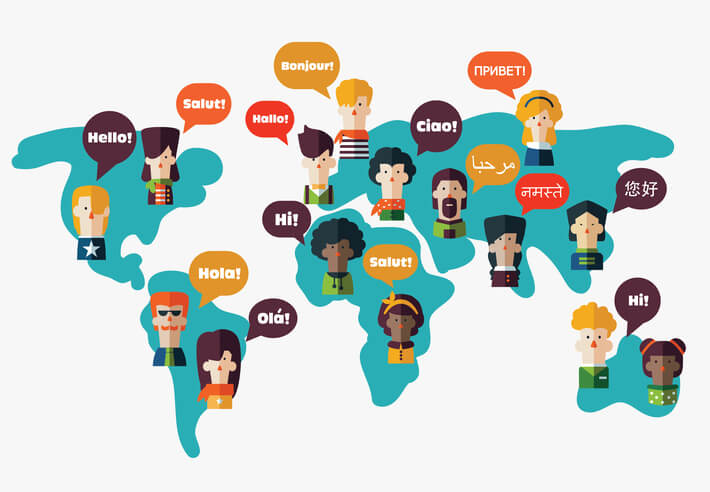 |
| Photo credit: PandaTree |
Other essential function of translation in the development of proficiency and intercultural competence is the acquisition of vocabulary and grammatical awareness. Learners of ESL enjoy of this benefit from translation in several ways, nevertheless, this cognitive process is very simple but requires constant practice, vocabulary acquisition and grammatical structures are acquired by context and repetition.(Popovic, n.d.) For instance, a learner who read and translate is going to find through a single reading new vocabulary that is there in a context and recurrent more than two or three times. Moreover, the same situation is observed in texts with grammar structures, there are patterns in the sentences subject, verb, predicate interjections or transition words that give the whole sense of order and structure to a text.
Finally, the intercultural competence is supported by translation through the same cognitive process we already mention. Students acquire new vocabulary and expressions that have their origin inside of the culture in which the language is spoken as: idioms and slang. These expressions not always make sense when are translated to the target language, so there should be a dialogue between the target language and the knowledge of the culture that the student making the translation, or the professional translator possess. Therefore, intercultural competence is achieved at the same time when the critical reading skills, grammar awareness, language and vocabulary acquisition help the person to become proficient in the target language.
In a nutshell, translation comes alive supporting students learning and helping language acquisition as well as achieving intercultural competence that make students and professional translators more competent in their practices and job.
References
Bosco, G. (n.d.). Translation Techniques. Retrieved from Interpro Tranlation Solutions: https://www.interproinc.com/blog/translation-techniques
Cleveland State University. (n.d.). CRITICAL READING: WHAT IS CRITICAL READING, AND WHY DO I NEED TO DO IT? Retrieved from Cleveland State University - The Writing Center: https://www.csuohio.edu/writing-center/critical-reading-what-critical-reading-and-why-do-i-need-do-it
Guerra, A. (2014, March 1). The usefulness of Translation in Foreign Language Learning: Students' Attitudes. [PDF] Retrieved from Universitat Jaume I - Repositori Universitat Jaume I: http://repositori.uji.es/xmlui/bitstream/handle/10234/134505/62499.pdf
Ordudari, M. (2007, July). Translation procedures, strategies, and methods. Translation Journal, 11(3). Retrieved from Cultural Aspects Translation Journal: http://www.bokorlang.com/journal/41culture.htm
Popovic, R. (n.d.). The place of translation in Language Teaching [PDF]. Retrieved from Sue Leather Associates: http://www.sueleatherassociates.com/pdfs/Article_translationinlanguageteaching.pdf


Comments
Post a Comment